Color Tutorial
How to Color Grass in 4 Ways
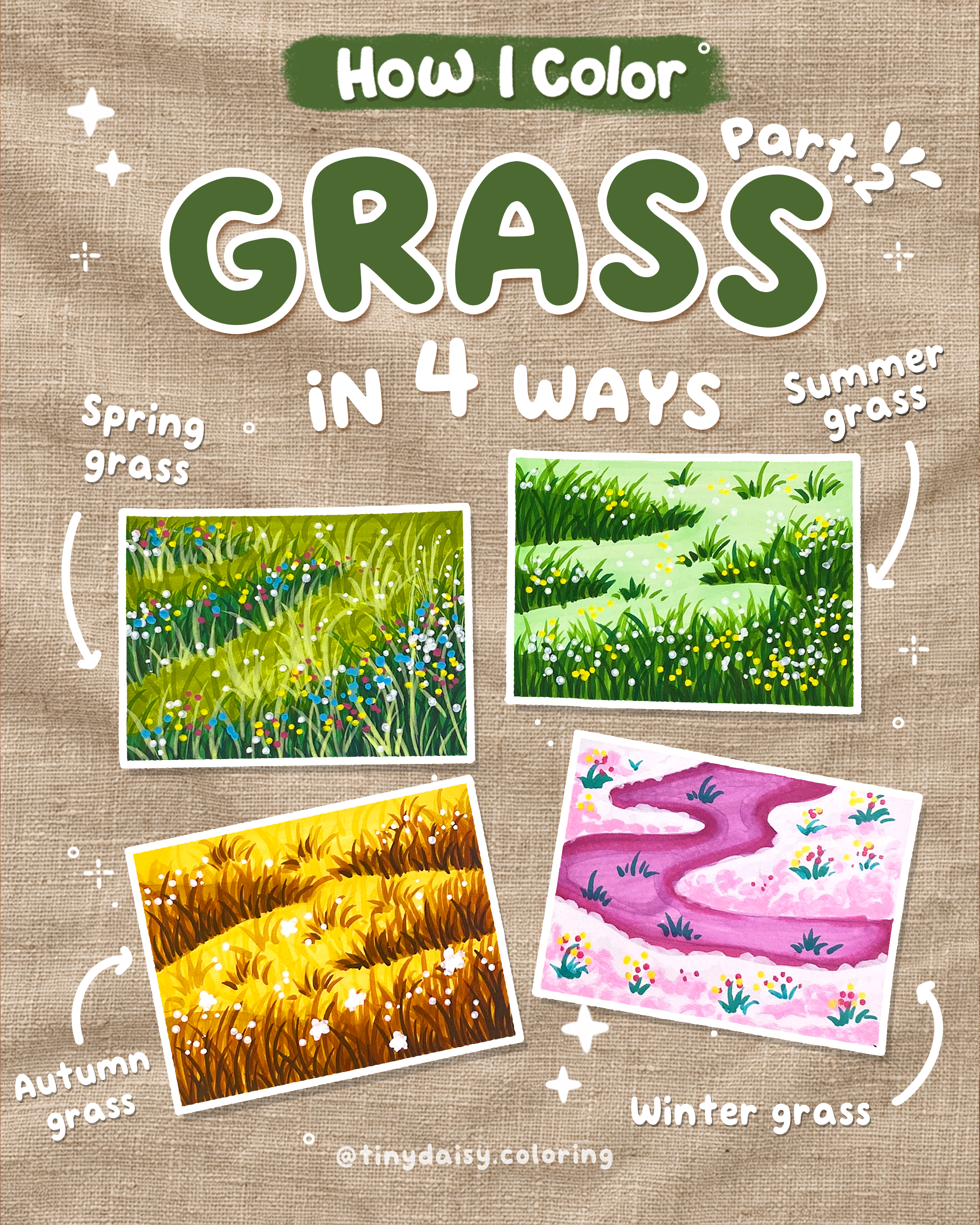
A grassy area may look simple at first, but it can do a lot to set the mood of a coloring page. Change the palette and a patch of grass can instantly feel like a bright spring meadow, a sunny summer field, a warm autumn landscape, or a playful winter scene.
For these four looks, we gave each season its own mix of colors, grass marks, shadows, and small decorative touches. Follow along with the steps below and see how differently the same element can be colored throughout the year.
Spring Grass
Spring gets the most colorful treatment of the four. Several greens overlap across the field, with lighter areas showing through between darker blades to keep the grass looking bright rather than heavy.
Blue, pink, and yellow touches are scattered among the greens at the end. These tiny bursts of color give the field a cheerful wildflower look and make the whole scene feel ready for spring.
Coloring Steps
- Step 1: Fill the grass with YG211.
- Step 2: Build the first grass texture and shaded areas with G310.
- Step 3: Bring more depth into the darker sections with YG414 and G316.
- Step 4: Place the acrylic accents using 576 and 700.
- Step 5: Finish with colorful grass marks in Y53, RV513, and B485.
Summer Grass
Summer moves into stronger greens and clearer contrast. Dark tufts gather around the edges of the lighter ground, creating separate pockets of grass instead of one continuous green surface.
Small yellow and white flowers brighten those deeper greens. Keeping the flowers scattered rather than filling every patch lets the rich summer grass stay at the center of the look.
Coloring Steps
- Step 1: Cover the grass area with G130.
- Step 2: Form the grass texture and first shadows with YG510.
- Step 3: Strengthen the deeper areas with G310 and YG414.
- Step 4: Finish the field with flowers in Y53 and acrylic 101.
Autumn Grass
For autumn, green gives way to a golden palette. Yellow forms the brightest parts of the field, while orange and earthy brown shades collect through the thicker rows of grass.
The darker strokes follow the curved sections of the landscape, which helps separate one golden layer from another. A few white accents add brightness against all those warm fall colors.
Coloring Steps
- Step 1: Lay down Y27 as the main autumn color.
- Step 2: Shape the grass texture with Y29.
- Step 3: Add the deepest warm tones using YR172, E130, and WG37.
- Step 4: Finish with white acrylic flowers using 101.
Winter Grass
This winter version leaves traditional green behind and turns the landscape pink and purple. The winding darker areas create separation through the snowy field, while pale sections make the scene feel lighter and softer.
Small blue-green leaves peek through the snow, joined by a few bright flowers. The unusual palette makes this version feel more whimsical than realistic, which works especially well for cute coloring pages.
Coloring Steps
- Step 1: Start the winter ground with V160.
- Step 2: Define the darker grass areas with RV320.
- Step 3: Create the snowy sections with white acrylic 101.
- Step 4: Give the snow more dimension with 658.
- Step 5: Add the small leaves using BG212.
- Step 6: Complete the scene with flower accents in RV513 and Y53.
One Landscape, Four Seasonal Looks
Color is what makes these four grass styles feel so different. Spring mixes lively greens with tiny rainbow accents, summer pushes the greens deeper, autumn replaces them with glowing gold and brown, and winter changes the ground completely with pink, purple, and snowy white.
Use these combinations as inspiration rather than a rulebook. You can keep the seasonal palette, borrow a texture you like from another version, or switch a few colors to make the grass fit your own coloring page.
Which season would you choose for your next page? 🌱☀️🍂❄️